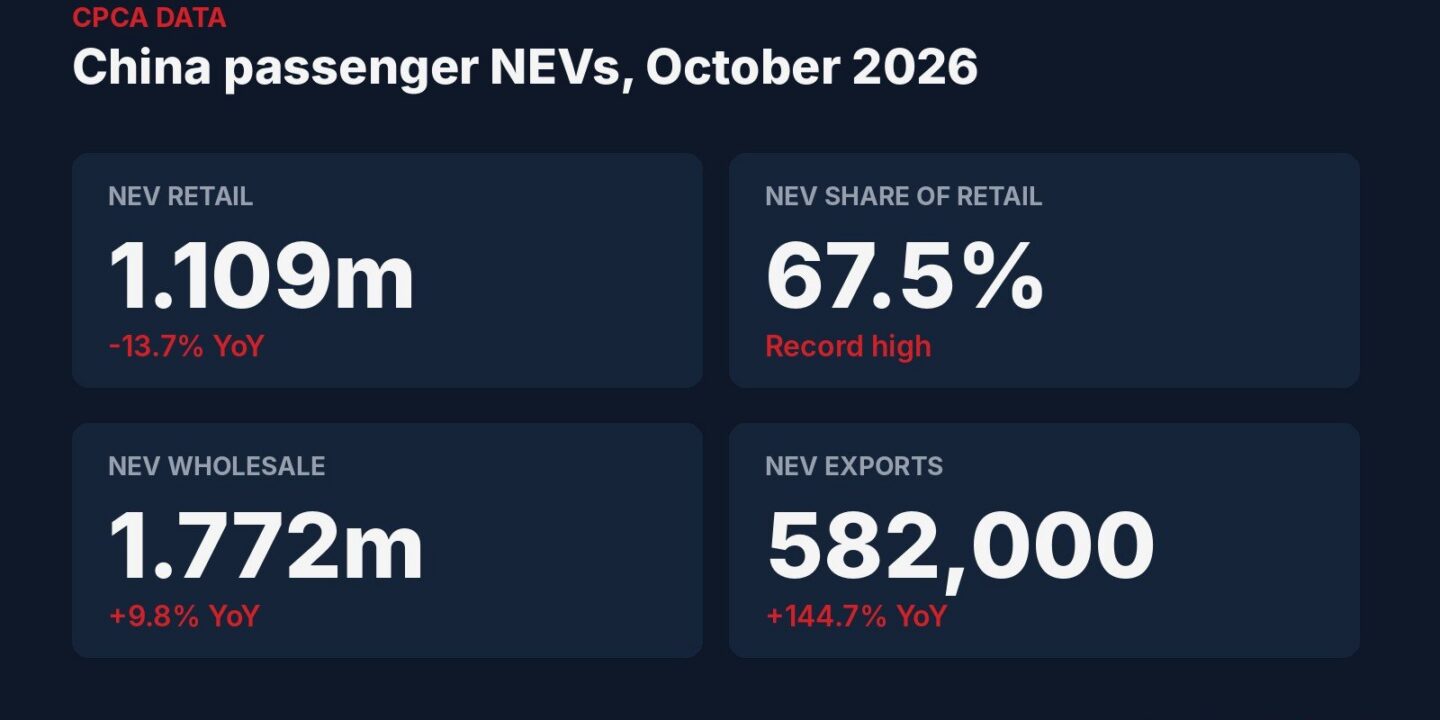
New energy vehicles took a record 67.5% of China’s passenger car retail sales in October, even though NEV retail sales fell 13.7% year-on-year to 1.109 million, according to final data from the China Passenger Car Association (CPCA). NEV exports more than doubled to a record 582,000.
It was the tenth month in a row that NEV retail sales were lower than a year earlier, though they rose 2.3% from September. The CPCA’s preliminary estimate last week had put October NEV retail at 1.148 million and penetration at 67.8%.
The wider market fell further. Total passenger car retail sales were 1.643 million, down 27.1% year-on-year, while sales of petrol and diesel cars dropped 45% to 530,000.
Across the first 10 months, NEV retail sales total 8.87 million, down 12.9%, and total passenger car retail is 14.98 million, down 22.3%.
By powertrain
Battery electric cars made up 770,000 retail sales, down 5.3% year-on-year. Plug-in hybrids fell 37.2% to 226,000, while extended-range EVs rose 1% to 114,000, up 31.2% on September, which the CPCA put down mainly to Xiaomi and Leapmotor.
Exports and wholesale
NEV wholesale sales, which include exports, rose 9.8% to 1.772 million. Exports accounted for 33% of that, up from 15% a year earlier, and NEVs made up 62.8% of all passenger car exports. Year-to-date NEV exports total 4.472 million, up 139.7%.
BYD led NEV exports with a 28.3% share, ahead of Chery (14.4%), Geely (13.8%), Tesla China (10.1%) and SAIC Passenger Vehicle (7.2%).
The CPCA warned that “short-term support for November exports should not be extrapolated into a sustained uptrend”, saying some orders had been brought forward ahead of expected cuts to export tax rebates and tariff changes, which could weaken exports in early 2027.
Manufacturers
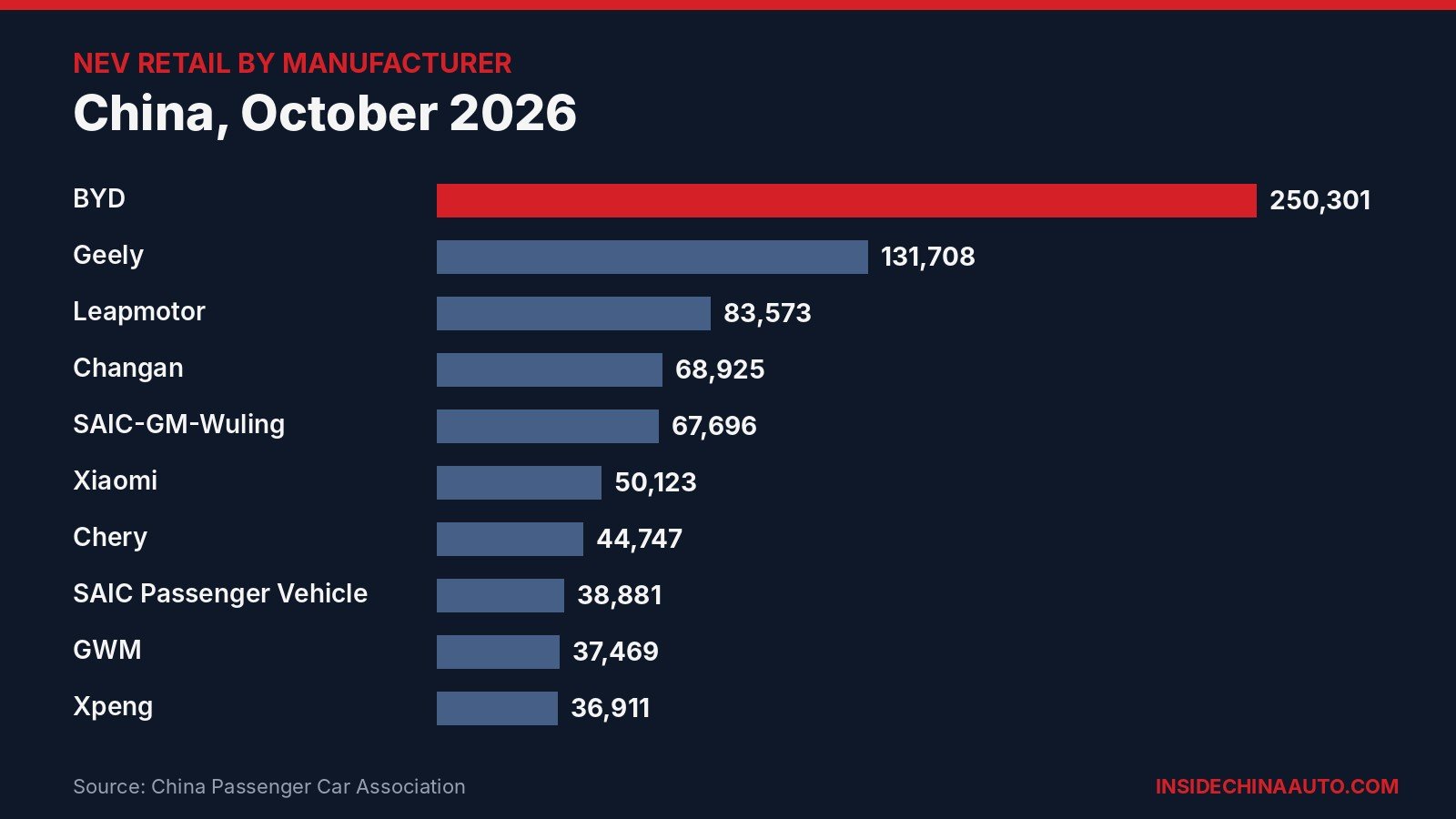
BYD sold 250,301 NEVs at retail in China, a 22.4% share, followed by Geely with 131,708 (11.8%) and Leapmotor with 83,573 (7.5%). Changan, SAIC-GM-Wuling, Xiaomi, Chery, SAIC Passenger Vehicle, GWM and Xpeng completed the top 10.
Tesla dropped out of the top 10, with 8,817 retail sales in China.
Including petrol cars, BYD took 15.2% of the overall market and Geely 11.9%. FAW-Volkswagen was the highest-placed joint venture in sixth.
| Manufacturer | NEV retail | Share | |
|---|---|---|---|
| 1 | BYD | 250,301 | 22.4% |
| 2 | Geely | 131,708 | 11.8% |
| 3 | Leapmotor | 83,573 | 7.5% |
| 4 | Changan | 68,925 | 6.2% |
| 5 | SAIC-GM-Wuling | 67,696 | 6.1% |
| 6 | Xiaomi | 50,123 | 4.5% |
| 7 | Chery | 44,747 | 4.0% |
| 8 | SAIC Passenger Vehicle | 38,881 | 3.5% |
| 9 | GWM | 37,469 | 3.4% |
| 10 | Xpeng | 36,911 | 3.3% |
Why sales are down
The CPCA said October was weak for what is usually a strong selling season. It said tighter eligibility rules for subsidies had held back first-time buyers, hitting the smallest A00 and A-segment cars hardest, while high oil prices continued to push buyers from petrol cars to NEVs.
“Funding remains available for trade-in subsidies, but their marginal impact is diminishing,” the CPCA said.
It expects a modest improvement in November, which has 21 working days, two more than October, with colder weather and migrant workers returning home expected to lift sales in county and rural markets.
Brand-by-brand deliveries for October are in our October live blog.