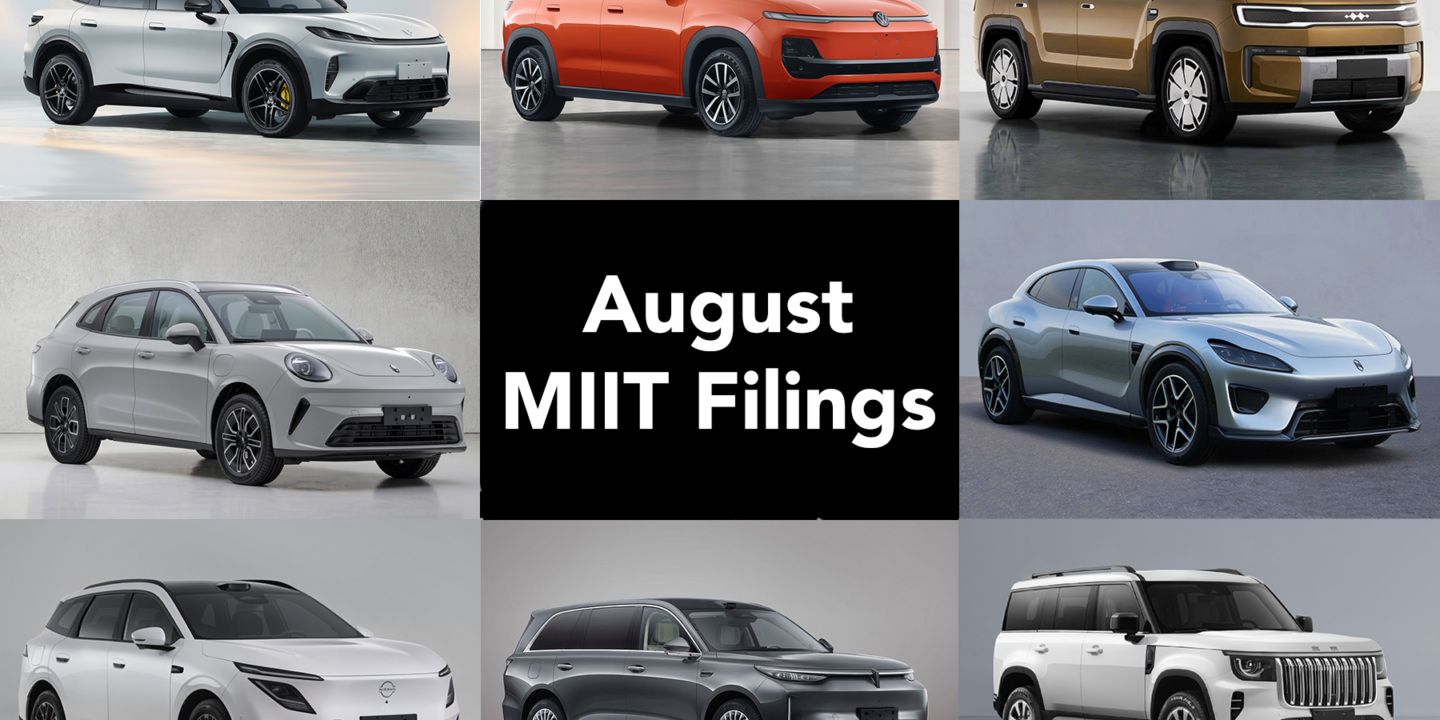
Extended BMW iX3, Mercedes-Benz VLE, and new electric VWs previewed alongside new local offerings from Luxeed, Wey, and more.
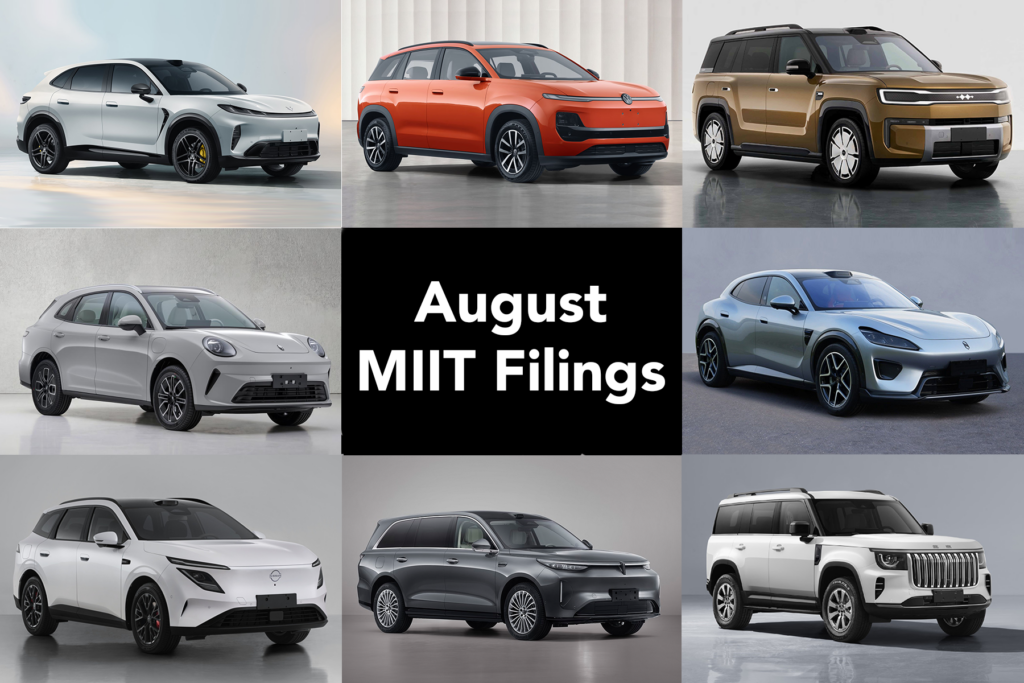
China’s Ministry of Industry and Information Technology has been calmly ruining every brand’s carefully planned launch schedule for years and is back again with a whole new batch of models from home and abroad.
The trends in full flow continue to be large SUVs, FUVs, and off-roaders, and in this batch we’ve got a few stunners and some ugly ducklings to wade through, as well as more attempts at a fightback from Europe’s finest, so let’s dive right in with those.
BMW iX3 (Neue Klasse)


We’ve been waiting for some real competition for the local brands and, following the sales disappointment that’s been the Mercedes CLA L, BMW is finally rocking up with a serious piece of electric kit with the long wheelbase version of their iX3.
At 4,885mm long, it’s still something of a baby in this company – quite a bit shorter than the likes of the Xiaomi YU7, but still around 10cm longer than the version the rest of the world gets.
Even then, it edges the YU7 on wheelbase at 3,005mm long, and comes equipped with similar power to the YU7’s mid-range Pro variant, offering a 116kW motor on the front axle and 235kW on the rear for a total of 351kW of around 470hp.
Battery size remains a mystery for now, but we know it’ll be a NMC unit from CATL. The question remains whether it can revive flagging fortunes in the Middle Kingdom. The price will be a major part in that.
Mercedes-Benz VLE


Mercedes’ answer to the fully-electric MPV boom is finally here, but probably about two years too late given everybody has already moved onto large SUVs and FUVs.
But an entry they have nevertheless, and one that’s somewhat less van-like than the EQV before it. It’s a big thing too at 5,310mm long, a fraction shorter than a Voyah Dreamer but still almost 20cm shorter than a Maextro V900, with a 9cm shorter wheelbase at 3,340mm.
Power comes from a 200kW motor on the front axle in single motor versions, with dual motor variants adding a 105kW motor on the rear axle, less than the base Zeekr 009, and less than half the 009’s maximum 680kW output.
The images reveal a 2+2+3 seating formation with second row captain’s chairs with screens in the armrests, but worth noting is the chunky third row seats which, when folded, still take a hunk of space and don’t fold into the floor like those on an XPeng X9.
Volkswagen ID. ERA 5X (SAIC-VW)


VW’s rapid range refresh shows no signs of abating with yet another ERA SUV entering the fray, this time in the high-volume compact SUV segment in the form of the 5X.
Produced by SAIC Volkswagen, the 5X will be the first product on the CMP (China Main Platform) architecture — a joint SAIC-VW effort at a China-native EV skateboard.
At 4,560mm long with a 2,815mm wheelbase, it’ll be going head-to-head with the likes of the BYD Yuan Plus and Geely Galaxy E5, but will run counter to the updates of both of those models by offering a single-motor front-drive producing 155kW.
For VW this is a bigger deal than the numbers suggest — CMP is meant to be their route out of the perpetual “too slow, too expensive” trap MEB has become in China, so if the ERA 5X actually launches at competitive money, the ID.4X and ID.6X can finally start getting some breathing room.
Fangchengbao Tai 9


Fangchengbao stormed into fifth place in the July NEV sales chart and now look set to add their largest model yet in the form of the Tai 9, joining the large, three-row SUV club.
At 5,270mm long, it’s larger than a Range Rover Long Wheelbase, but gets a slightly shorter wheelbase at 3,130mm, which is still plenty of room for the six seats it needs to accommodate.
As expected, it’ll get the same DMO plug-in hybrid powertrain as the Bao 5, with a 1.5-litre engine producing 110kW and capable of driving the wheels joining a pair of 200kW electric motors at either end, but it won’t be a body-on-frame model so will go lighter on the rough stuff.
It’ll likely come equipped with Huawei ADS like sister models, and sports 21- or 22-inch wheels.
Wey V9X BEV


GWM’s Wey brand has long trodden the PHEV route within the stable but, just as sister brand Ora turns from EV towards ICE, Wey looks set to drop its first fully electric SUV in the form of the V9X, which is debuted here in extended wheelbase form.
Measuring in at 5,299mm long, it’s one of the longest SUVs on the Chinese market, and accommodates a sizeable 3,150mm wheelbase, enough for three-rows and six-seats.
Power will be just as large, with dual motors producing 220kW at the front and 320kW at the rear for 540kW, or well over 700hp.
Wheels come in a pair of 21-inch variants, including dish-style, while the popular two-tone paintwork trend will also be offered.
Luxeed RX


Over at Luxeed, we’ve got the latest in what will likely be a long line of rivals to the Xiaomi YU7, this one called the RX.
Set to arrive in two flavours: a single-motor rear-drive version with 277kW and a dual-motor all-wheel-drive with 160kW front + 277kW rear , so a punchy 437kW combined. Both are 5,020mm long with a 3,000mm wheelbase.
It’s set to use CATL NMC batteries and come, like the YU7, in a variety of colours and flavours, with the filings revealing different colour badges and wheel caps, and alloys, and there’s an Ultra+ trim expected to feature Huawei’s latest ADS 5 assisted driving system.
An interesting detail in the filings is what appears to be active aero options in the front splitter and rear diffuser, suggesting it’ll be aiming at real performance.
Arcfox aT7


Rivals to the Xiaomi YU7 are stacking up and Arcfox has thrown its hat into the ring with the aT7, a somewhat less sleek but still rather attractive two-row SUV.
According to the filings, both BEV and EREV versions will be offered, with the BEV offering up 227kW and the EREV 200kW from its electric motor, and a 1.5-litre engine providing additional range.
The aT7 comes in slightly longer than a YU7 at 5,020mm long, the same length as the Luxeed RX, but gets a longer wheelbase at 3,040mm and sits about 7cm taller. 19- and 21-inch alloys will be offered.
Dongfeng Nissan N7 PHEV


Nissan’s new BEV and PHEV models have completely rejuvenated Nissan’s ageing line-up and the portfolio expansion continues with the new NX7, a plug-in hybrid to sit under the larger NX8 BEV.
It’s 4,785mm long with a 2,815mm wheelbase, so slightly smaller than the BEV, and the powertrain looks to be a 170kW electric motor supported by a 1.5-litre engine. Battery is LFP from CATL’s FAW joint venture, Time-FAW.
For Nissan globally, this is a big deal — the N7 PHEV is essentially Nissan’s first proper China-designed, China-built PHEV, and if it works here it’s going to be Nissan’s template for a lot of markets outside the US.
BAIC Xingtan 5X (ICE/PHEV/BEV)


Looking like a Land Rover Defender that’s been deployed in Angry Birds, the Xingtan 5X is a new mid-to-large off-roader from BAIC that gets a full three powertrain options, with ICE, PHEV, and BEV making sure there’s a boxy SUV for everyone.
The one with the Hongqi-esque grille is the ICE, which will utilise a 2.0-litre petrol engine delivering 180kW of power. It measures in at 4,860mm long, or 5-metres with the box on the back, 2-metres wide, and 1,910mm tall, with a wheelbase of 2,875mm.


The BEV and PHEV models get a sleeker, closed front end, with the only major difference being the additional ventilation in the lower grille on the PHEV.
In BEV mode, there’s a single 227kW electric motor, which makes it somewhat more brisk than the ICE, but given it also comes in around 300kg heavier, it needs the extra power.


The PHEV is arguably the best option, combining a 1.5-litre engine producing 100kW of power, with a front-mounted electric motor producing 200kW for what should be a pretty punchy product, though this is even heavier than the BEV.
Alloys will come in either 19-, 20-, or 21-inch options.
Wuling Xingguang M


Wuling’s MPV offering looks set to expand beyond the 730 into larger territory with the Xingguang M.
Measuring in at 5,150mm long, 1,920mm wide, and 1,820mm tall, and with a 3,000mm wheelbase, it’ll get a plug-in hybrid drivetrain with a 1.5-litre engine and an electric motor, both of which look to produce about 100kW each, though the filing isn’t clear.
The battery will be of the LFP variety and likely comes from SAIC’s in-house battery arm or Gotion.
Jetour Traveller (BEV)


Chery’s Jetour brand looks set to enter the full EV space with its compact Traveller model set to offer single and dual motor variants, and cartoon raccoon-like styling to boot.
Single motor versions will get a 200kW motor on the rear, with dual motors adding a 75kW motor on the front, giving Jetour a direct competitor to the Deepal S05 and Leapmotor B10.
At 4,475mm or 4,605mm long, presumably dependent on whether the car is specced with the funky little backpack or not, it slots in about the X50 in the brand’s range, and while Jetour doesn’t yet sell in Europe, you could see this potentially being a candidate.
ORA 5 Touring


GWM’s Ora brand has gone through some dire straits of late but looks a brand revived in recent months courtesy of the new 5 SUV and the introduction of multiple powertrains.
Looking to build on its success, we now get the first images of the new 5 Touring, which takes the 5’s already gawky appearance and shovels on a whole load more awkwardness.
We know the model has already been teased in Australasia, so international sales seem a cert, and there’ll likely be a choice of four powertrains on offer there too with full EV, plug-in hybrid, micro hybrid, and petrol variants all featuring in the MIIT filings.
At 4,758mm long, it’s nearly 30cm longer than the standard 5, but retains the same 2,720mm wheelbase, hence the eye-watering rear overhang.
212 X03


Finally, the 212 brand looks set to get the second model that debuted at the Beijing Auto Show, named the X03.
At 5,095mm long, it’s quite a bit larger than the T01, but will keep things simple with a two-row, five-seat set up for now.
The drivetrain is something of a curio in the Chinese market, with a diesel engine producing 140kW the only option. Diesel, for those who might not know, isn’t exactly the easiest fuel to find in China given 99.9% of ICE cars run on petrol.
33- and 30-degree approach and departure angles suggest the brand is very much sticking to its off-road roots.