New energy trucks took 50.3% of China’s heavy truck sales in September, up from 28.9% a year earlier, as overall heavy truck sales fell 21%.
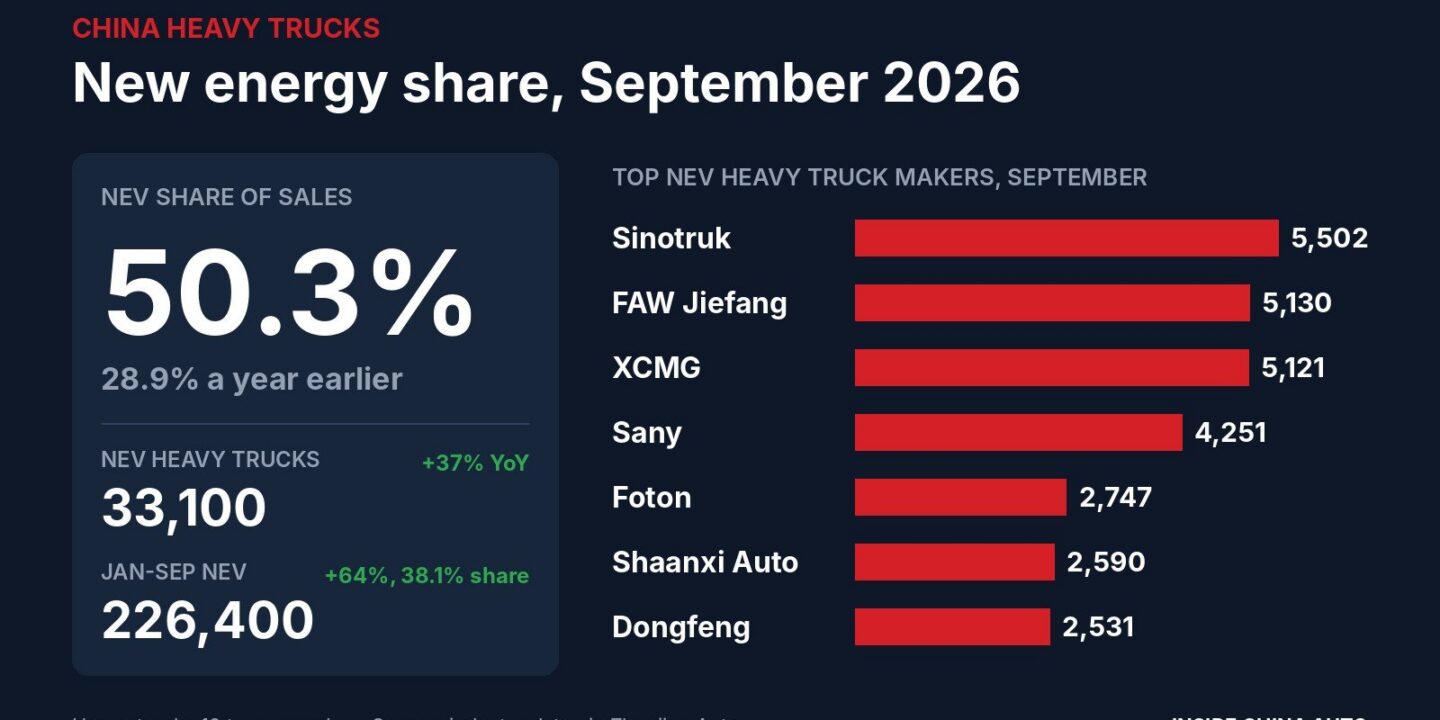
New energy vehicles made up more than half of China’s heavy truck sales in September, according to industry data reported by Chinese outlet Zhuojian Auto. Sales of new energy heavy trucks rose 37% year on year and 23% on August to 33,100, taking 50.28% of the market, up from 28.93% a year earlier, while total heavy truck sales fell 21%.
It was the fifth month in a row that the new energy share has been above 40%. Every one of the ten best-selling new energy heavy truck models this year is a plug-in battery electric truck, and nine of them are tractor units.

Tractors lead the way
The shift is fastest among tractor units, the trucks that pull trailers on long-distance routes. New energy tractors sold 25,600 units in September, a 64.48% share of the segment, with FAW Jiefang the biggest seller on 4,607.
From January to September, 226,400 new energy heavy trucks were sold, up 64% year on year, giving them 38.1% of the market. That’s already close to the 231,100 sold in the whole of 2025, when they had a 28.9% share, according to Electrek.
Sinotruk on top
Sinotruk, China National Heavy Duty Truck Group, led the September new energy heavy truck market with 5,502 sales, up 112% year on year and a 16.6% share. It was ahead of FAW Jiefang on 5,130 and XCMG on 5,121, followed by Sany on 4,251, Foton on 2,747, Shaanxi Automobile on 2,590 and Dongfeng on 2,531.
Sinotruk also leads for the year so far with 36,600 sales, ahead of XCMG on 35,900, Sany on 31,400 and FAW Jiefang on 29,000. The top ten makers account for 92.1% of the market. Sany’s battery electric tractor is the best-selling single model this year, with 4,595 sales.
Why the switch
Zhuojian Auto puts the growth down to the phase-out of older China IV and V diesel trucks, a requirement for new heavy trucks with operating permits to be fitted with automatic emergency braking, and high oil and gas prices that have weakened the case for LNG-powered trucks. Electric trucks have also spread from closed sites such as ports, mines and steel mills to highway freight.
LNG trucks held nearly 30% of the heavy truck market in 2024, but by July 2026 electric trucks had 47% of heavy-duty registrations and LNG just 11%, according to energy data firm Kpler, as reported by Electrek.
Battery maker CATL is building a heavy truck battery swapping network through its Qiji brand, which ran around 300 swap stations at the end of 2025 and plans 900 by the end of this year and 2,000 in 2027. In August CATL agreed to pay RMB 2.56 billion (approx. US$376 million) for almost 25% of Qiyuan Green Power, which operates more than 1,600 charging and swap stations.
Eleven Chinese government departments have set a target of 40% new energy heavy truck sales by 2030, along with 1.6 million new energy heavy trucks on the road, around 3,000 charging and swap stations and 30,000km of zero-carbon freight corridors. The monthly figure has already passed it.